 by
by Content vs. AI knowledge is, to my mind, a major question. When the cost of producing content tends toward zero, and the abundance of content therefore becomes the norm, I found it worthwhile to ask what still creates value. For what is abundant is, by definition, little valued, whereas what is rare is valued more. This led me to reflect on content, knowledge, and intelligence, and on the place of time in the process of intellectual production. This article aims at nothing more than to open the debate, and makes no claim to be at the scientific cutting edge: it is a point of view on a subject I find fascinating.
Table of Contents
Why knowledge irreducibly requires human time
We are living through a paradox that few generations have known with such intensity: producing content now costs almost nothing, neither in money nor, above all, in time, while producing knowledge or intelligence still demands the slow, costly, laborious duration of a human brain. In a few seconds, a language model writes an essay, sketches the outline of an article, offers ten stylistic variations. This fluency is staggering, and it feeds a confusion that strikes me as the great intellectual misconception of our era: mistaking the ease of content for the depth of thought.
My thesis is simple, and I want to defend it with the most recent research. What defines content, its near-instantaneous production, is precisely what disqualifies it as an indicator of intelligence. It is at most a simulation of intelligence, an artifice that creates a kind of illusion. Content has collapsed toward zero time.
Knowledge, for its part, remains temporal by nature, because the cerebral mechanism that fabricates genuinely new ideas is itself biologically, irreducibly slow. The real dividing line is neither coherence, nor grammar, nor even apparent relevance. It is human time. For we are, in fact, AI’s limiting factor: we process less information, more slowly, with a lesser capacity to identify regularities.
One clarification, at the outset, to avoid the misunderstanding. My target is not AI as such, but a certain use of AI: the one that consists in delegating to it not the drudgery, but the effort. The whole stake, as we will see, rests on a distinction I will keep for the end: there is a time that can be entrusted to the machine without harm, and a time that cannot be outsourced without ceasing to think.
I. Three levels: content, knowledge, intelligence
To think through this content-vs.-AI-knowledge divide, we must first stop asking the wrong question. Asking whether a machine “thinks” is a semantic trap, because we already know the answer, by construction: no. It seems to me more fruitful to distinguish three levels.
The first is content: a coherent linguistic or visual form, produced by statistical recombination of what already exists. This is what generative models now achieve with remarkable ease. The second is knowledge: content anchored in a model of the world, verifiable, structured by causal and not merely probabilistic relations. The third is intelligence in the strong sense: the capacity to form new ideas that in turn modify the conceptual framework within which they emerged.
This hierarchy is not arbitrary. It extends a distinction Karl Popper had formulated well before AI. Popper separated World 1 (physical objects), World 2 (subjective mental states), and World 3, the realm of the objective products of the mind: theories, books, proofs, works. Popper’s decisive point is that the objects of World 3 possess an autonomy. A proof may contain a theorem its author had not perceived. A novel gives rise to interpretations the writer had not intended. A genuine idea turns against the one who formulates it and constrains them like a discovery [1].
This is exactly the criterion that separates the idea from content. Margaret Boden distinguished three forms of creativity: combinational (associating known elements in new ways), exploratory (traversing the boundaries of an existing conceptual space), and transformational (modifying the very rules that define that space). Only the third produces a true leap, and Boden linked it directly to Thomas Kuhn’s paradigm revolutions [2].
The use of AI in content production, and the homogenization that follows, should prompt us in return to cultivate our difference in thinking, to develop a plurality of experiences and forms of knowledge, and to move to action more quickly. A new idea resides in the improbable, in the gap, in the unexpected, in surprise.
Bergson said the same thing in another language: analytical intelligence, the kind that decomposes and computes, is a fossilized form, whereas authentic creation springs forth and cannot be deduced from what precedes it. Measured against these three levels, generative AI excels at the first, progresses toward the second, and remains, philosophically as much as neurologically, rather far from the third, at least as long as it is not orchestrated by a human.
II. Content has become instantaneous, and that is precisely the trap
The ease of content is not a technical detail. It has a measurable consequence, and the most rigorous studies of the past two years document it: AI-produced content converges toward the average.
The reference study is Doshi and Hauser’s, published in Science Advances in 2024. In a controlled experiment, participants did or did not receive story ideas generated by a language model. The result: the AI-assisted stories were judged more creative and better written, especially among the least gifted authors at the outset. But those same stories resembled one another more. The researchers measure a 10.7% increase in similarity between the texts of authors who used a single AI idea, compared with the group without assistance [3]. The authors speak of a social dilemma: individually beneficial, collectively impoverishing.
The use of AI and the homogenization that ensues should prompt us, in return, to cultivate our difference in thinking, to develop a plurality of experiences and forms of knowledge, and to move to action faster. It is a counter-signal: the more content standardizes, the more value shifts toward what stands out, toward what is not already in the average.
This finding is not isolated. A 2025 meta-analysis covering twenty-eight studies and more than eight thousand participants gives precise orders of magnitude: no significant difference in individual creative performance between human and AI (g ≈ −0.05), a clear advantage when the human collaborates with AI rather than working alone (g ≈ 0.27), but a spectacular drop in the diversity of ideas (g ≈ −0.86) [4].
A review published in Trends in Cognitive Sciences goes further and names the phenomenon: the homogenizing effect of language models on expression and thought. The authors warn that the models reflect and reinforce dominant styles while marginalizing minority voices and reasoning strategies, and that the systematic prompting to reason “step by step” risks discouraging the intuitive and associative modes of thinking that are nonetheless crucial for problem-solving [5]. A 2026 meta-analysis aggregating nineteen studies confirms a weak but robust homogenization effect, more pronounced in constrained ideation and liable to persist beyond the co-creation session [6].
Content optimizes for the probable: a language model produces, by construction, the most likely continuation. Yet the new idea resides in the improbable, in the gap, in the unexpected trajectory through the space of concepts, in surprise. The very ease of content pulls it toward the statistical center of gravity of what has already been thought, and “digested” by the LLM’s mathematical model. This is why fluency cannot serve as an indicator of thought: it measures, rather, the opposite of what counts.
III. Irreducible human time: what neuroscience tells us
I come now to the heart of my argument. If content is instantaneous and the idea laborious, this is not by cultural accident. It is because the biological mechanism that produces genuine ideas is intrinsically temporal. Time is not a delay to be eliminated. It is the mechanism itself.
The neuroscience of creativity saw, in 2025, an advance that illuminates this point. Becker and Cabeza, in Trends in Cognitive Sciences, propose a theory of insight as prediction error. Illumination, the famous “Aha!”, would arise from a gap between what the brain predicted and what it encounters: the hippocampus detects this error, the medial prefrontal cortex integrates it, dopamine signals the reward, and noradrenaline amplifies the salience. A crucial detail: this gap, this surprise, durably strengthens memory, which explains why ideas found through insight take hold better than those received passively [7]. A converging perspective, drawn from the work on the predictive brain by Friston and Clark, shows how a brain that nonetheless seeks to minimize uncertainty can still create, partly thanks to the structure of its environment [8].
But surprise takes time. For a prediction error to occur, one must first have predicted, and therefore actively committed oneself, and therefore failed. This is why the fruitful error, the unsuccessful attempt, the backtracking are not wasted time: they are the very conditions of the idea. Stanislas Dehaene sums up effective learning in four pillars: attention, active engagement, error feedback, and consolidation. All four are temporal, and none is satisfied by merely reading ready-made content. It is here that the substitutive use of AI risks costing the most, not by lowering a grade, but by spiriting away the very conditions through which knowledge settles in and turns into competence.
To this are added two other dimensions of cerebral time. First, incubation: ideas mature in the background, during daydreaming, sometimes during sleep. A preregistered 2025 study shows that mind-wandering during an incubation phase predicts the subsequent improvement of creative performance. Second, the oscillation between the brain’s major networks: creativity, measured by divergent thinking, is predicted by the number of switches between the default mode network, the network of daydreaming and free association, and the executive control network, that of critical judgment. The relationship follows an inverted U-curve, which means one needs neither too few nor too many switches: a dosage that is built over the duration of real work [9]. For my part, the time I spend writing these step-back articles lets me work on writing as the formalization of thought, then on the sedimentation and consolidation of ideas through the exchanges that follow publication.
Finally, and this is perhaps the most striking argument, doing the creative work physically transforms the brain. A 2026 review in Frontiers in Human Neuroscience documents the plasticity induced by artistic training, which notably strengthens connectivity between networks [10]. Reading content produced by a machine triggers none of these adaptations. Knowledge is not merely an object one possesses: it is a lasting modification of the one who elaborates it. For this reason, it seems to me extremely important to cultivate an openness to art, in whatever form: music, painting, photography, drawing, singing, it does not matter. To spend time practicing an art is to spend time “building up” one’s brain, usefully, in the face of AI.
Content, by collapsing toward zero time, produces none of these transformations, because it removes precisely the duration that makes them possible.
IV. What the machine does not yet have: a model of the world
One might object that the models will close this gap at some point. This is, I believe, the object of an intense scientific debate, and it must be presented honestly, for to my mind it is by no means settled.
The most critical current regarding language models is carried by Yann LeCun, whose program defends a fundamental thesis: intelligence requires a model of the world, that is, the capacity to represent states of the world in causal terms and to plan in an abstract representation space, rather than predicting the next word. His V-JEPA 2 architecture, trained on more than a million hours of video, enables robotic planning without retraining [11]. Its theoretical version, LeJEPA, formally demonstrates the optimal embedding distribution, replacing heuristics with proofs [12]. Very recently, in 2026, work by Klindt, LeCun, and Balestriero establishes under what conditions this type of model actually learns the world’s latent variables. This result is only a few days old at the time of writing, and it must be cited with the caution due to a very fresh preprint [13].
On the empirical side, language models still stumble over the physical world. The study presented at NAACL 2025, mischievously titled “the stochastic parrot on the model’s shoulder,” shows that state-of-the-art models, including GPT-4o and the most recent reasoning models, remain about 40% behind humans in “understanding” physical concepts, even though they describe them perfectly in natural language [14]. This is the experimental confirmation of Searle’s founding philosophical argument: the Chinese Room manipulates symbols according to impeccable rules without understanding anything. Syntax does not generate semantics. That formula is illuminating, put another way: content no longer translates thought.
Should we conclude that the models understand nothing? The philosophical debate of 2025 and 2026 sketches a spectrum rather than a verdict. At one pole, Bender and Hanna hold that the models’ “understanding” and “agency” are illusions sustained by marketing, in the lineage of the founding article on stochastic parrots [15]. At the center, Lederman and Mahowald propose a position of “bibliotechnism”: the models would be cultural technologies whose new text inherits its meaning from the original human text [16]. At the other pole, philosophers defend a graded and mechanistically grounded understanding.
Beckmann and Queloz, in Philosophical Studies, argue that certain internal mechanisms of the models justify a non-metaphorical attribution of understanding [17], while Mollo and Millière contend that internal states can acquire a genuine reference to the world, without even requiring a body or multimodality [18]. For my part, I align myself with a current of thought holding that all high-level cognitive activity is sensorimotor in nature (Barsalou, 1999) [26], which places me de facto within this spectrum, on the side of those for whom the absence of a body and of experience weighs heavily.
This debate is fascinating, but it must be noted that even the most optimistic pole speaks of understanding a piece of content, not of the autonomous production of ideas that turn against their author. Above all, one fact remains, and it is decisive in light of the neuroscience set out above: the machine is not surprised by its own outputs. Let us be clear, for this is where one quickly over-interprets: a gap between what a model predicts and what it observes can perfectly well be measured, and even exploited to train it.
What the machine lacks is not the computational gap; it is lived surprise, the surprise that, in us, triggers the biological cascade of insight and engraves the idea in memory. It lives no prediction error in the felt sense of the term, no “Aha!”, no consolidation, no plasticity (even if one is beginning to simulate certain aspects of it through a recursive improvement of context framing in markdown files). The biological engine of the idea is foreign to it.
V. The cost of skipping time, and the time that must not be skipped
What happens when a human, seduced by ease, delegates to the machine not only the shaping but also the temporal work of thought? The 2025 studies are severe.
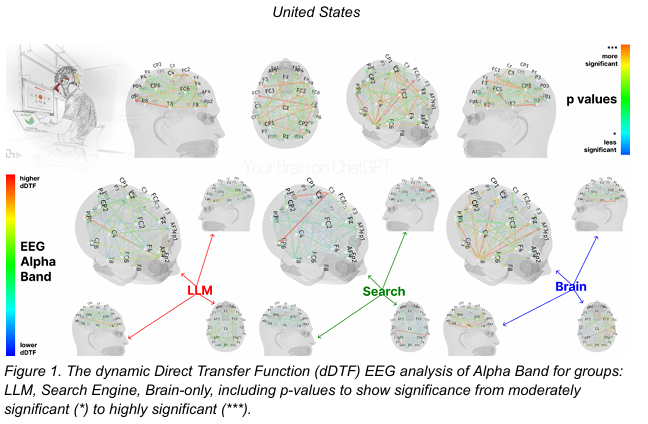
The famous MIT Media Lab EEG experiment compared writers working with a language model, with a search engine, or alone. The model’s users displayed the weakest and least distributed brain connectivity (which is hardly a revelation in itself), retained their own text poorly, and felt little ownership of it. The authors then speak of “cognitive debt,” and this provoked much reaction. I note, however, that it is a preprint not yet peer-reviewed to date, which was the subject of a critical commentary in 2026 on its methodology and its small sample: to be handled, therefore, with caution [19].
Other findings, these published, point in the same direction. A randomized study published in the British Journal of Educational Technology observes that using ChatGPT improves grades but neither knowledge acquisition, nor its transfer, nor motivation, and reduces engagement in the self-regulation processes of learning. The authors name this phenomenon “metacognitive laziness” [20].
A survey of 666 people establishes a negative correlation between frequent use of AI tools and critical thinking, mediated by cognitive offloading [21]. A study by Microsoft and Carnegie Mellon, conducted with 319 knowledge workers, shows that the higher the confidence in AI, the lower the effort of critical thinking [22]. The philosopher who has best theorized this risk speaks of a “hollowed-out mind” and a “sovereignty trap”: the frictionless availability of ready-made answers makes it possible to systematically bypass costly cognitive processes, to the point of mistaking access to information for actual capacity [23]. To skip time is to skip the formation of the mind.
Should we therefore lapse into catastrophism? No, and this is where the thesis must be refined, for it would be false if left as it stands. To say that “AI removes time” is not enough. The real question is not how much time it removes, but which time it removes.
Let us then distinguish two times that intellectual production ordinarily conflates. There is the time of production: looking up a reference, shaping a text, reformulating it cleanly, exploring a body of literature, generating examples. And there is the time of transformation: problematizing, judging, getting it wrong and understanding why, letting an idea incubate, appropriating it to the point of being modified by it. The first is largely logistical. The second is cognitive in the strong sense: it is precisely the one the neuroscience described above shows to reconfigure the brain.
Now, AI can compress the first without touching the second, and then it is a blessing: it relieves me of the documentary drudgery to make me available for interpretation. The danger appears only when one believes one can also compress the second, when one delegates no longer the shaping but the very friction of thought. The same sentence, typed into the same interface, can therefore impoverish or enrich, depending on whether it spirits away the time of transformation or frees up time of production for its benefit.
This distinction sheds light on a use my argument has so far neglected, and which is probably the most promising. The AI-prosthesis produces in my place and impoverishes me. But there exists an AI as a friction partner that does not produce for me: it contradicts me, generates objections I had not seen, opposes my theoretical framework with a rival one, simulates the controversy I would not have known how to conduct alone.
Far from removing the time of transformation, this use of AI intensifies it: it multiplies the gaps between what I predicted and what is opposed to me, hence the occasions for surprise, hence the very engine of the idea. It is also, incidentally, one of the rare antidotes to the homogenization described above, since it serves me perspectives I would not have generated. The decisive boundary therefore does not run between the human and the machine; it runs within my own uses: between the AI that exempts me from thinking and the AI that compels me to think better.
AI as an extension, provided we keep the right tempo
The most fruitful reading is probably Andy Clark’s, co-author in 1998 of the extended mind thesis, which he updated in 2025 in Nature Communications: it is in our nature to build hybrid systems of thought, and AI’s suggestions can be treated as thoughts that “come up” in the course of a conversation, both welcomed and questioned, examined to see whether they truly make sense [24]. The crucial nuance is provided by Hernández-Orallo: the gains of extended cognition are lost as soon as the tool disappears or fails, unlike internalized competence [25]. AI does not replace the thinking subject; it can become part of his cognitive ecology. Provided that the subject, for his part, remains a subject.
This is where the boundary plays out. AI increases the production of ideas when the human retains the costly, evaluative, generative work, and therefore the time of transformation. It hollows that production out when it substitutes itself for the work. The discipline of our era consists in protecting that time as the rare resource that turns content into knowledge: the time of error, of surprise, of incubation, of the switch between daydreaming and judgment, the time that physically modifies the one who thinks.
At bottom, it is not AI that threatens knowledge. It is a use of AI: the one that removes the time necessary for appropriation, judgment, fruitful error, and self-transformation. Reformulated this way, my thesis loses its facile edge against the machine and gains its true target. For the initial paradox then unties itself: precisely because content has become free and instantaneous, time becomes once again, to my mind, the true measure of intelligence. Producing content, from now on, proves nothing. Producing knowledge, by contrast, still attests that a mind has taken the time to transform itself by thinking, to think by transforming itself, even to make its own thought evolve. And this, no machine, for the time being, does in our place, even if artificial intelligences, well used, can powerfully contribute to it.
Références
[1] K. R. Popper, Objective Knowledge: An Evolutionary Approach, Oxford University Press, 1972. Sur l’autonomie du Monde 3, voir aussi les discussions contemporaines, par ex. Studia Humana et Social Studies of Science sur « Is Popper’s Third World Autonomous? ».
[2] M. A. Boden, The Creative Mind: Myths and Mechanisms, 2e éd., Routledge, 2004 ; et J. Gero et al., « Transformational Creativity in Science: A Graphical Theory », arXiv:2504.18687, 2025.
[3] A. R. Doshi, O. P. Hauser, « Generative AI enhances individual creativity but reduces the collective diversity of novel content », Science Advances, vol. 10, n° 28, eadn5290, 2024. DOI : 10.1126/sciadv.adn5290.
[4] S. Holzner, M. Maier, S. Feuerriegel, « Generative AI and Creativity: A Systematic Literature Review and Meta-Analysis », préprint, arXiv:2505.17241, 2025. Chiffres d’effet à vérifier sur la version finale.
[5] Z. Sourati, A. H. Ziabari, M. Dehghani, « The homogenizing effect of large language models on human expression and thought », Trends in Cognitive Sciences, 2026 (en ligne 2025). Préprint : arXiv:2508.01491.
[6] M. de Rooij, M. M. Biskjaer, « Does generative AI make us think alike? A systematic review and three-level meta-analysis of homogenization effects in human–AI co-creation », préprint OSF, 2026. DOI : 10.31234/osf.io/rz5s4_v1.
[7] M. Becker, R. Cabeza, « The neural basis of the insight memory advantage », Trends in Cognitive Sciences, vol. 29, n° 3, p. 255, 2025. DOI : 10.1016/j.tics.2025.01.001. Voir aussi M. Becker, Y. Wang, R. Cabeza, « Surprise!—Clarifying the link between insight and prediction error », Psychonomic Bulletin & Review, 2024, DOI : 10.3758/s13423-024-02517-0.
[8] A. Constant, K. Friston, A. Clark, « Cultivating creativity: predictive brains and the enlightened room problem », Philosophical Transactions of the Royal Society B, 2024. DOI : 10.1098/rstb.2022.0415.
[9] C. Chen et al., « Dynamic switching between brain networks predicts creative ability », Communications Biology, 2025, DOI : 10.1038/s42003-025-07470-9 ; et « Mind wandering during creative incubation predicts increases in creative performance in a writing task », Scientific Reports, 2025, DOI : 10.1038/s41598-025-09736-y.
[10] « Brain plasticity in response to artistic and non-artistic training aimed at promoting creativity », Frontiers in Human Neuroscience, 2026. DOI : 10.3389/fnhum.2026.1632331.
[11] M. Assran et al., « V-JEPA 2: Self-Supervised Video Models Enable Understanding, Prediction and Planning », Meta AI, arXiv:2506.09985, 2025.
[12] R. Balestriero, Y. LeCun, « LeJEPA: Provable and Scalable Self-Supervised Learning Without the Heuristics », arXiv:2511.08544, 2025.
[13] D. Klindt, Y. LeCun, R. Balestriero, « When Does LeJEPA Learn a World Model? », préprint arXiv, mai 2026. Résultat très récent, à confirmer.
[14] M. Yu et al., « The Stochastic Parrot on LLM’s Shoulder: A Summative Assessment of Physical Concept Understanding », NAACL 2025. DOI : 10.18653/v1/2025.naacl-long.569. Argument philosophique de référence : J. Searle, « Minds, Brains, and Programs », Behavioral and Brain Sciences, 1980.
[15] E. M. Bender, A. Hanna, The AI Con, Harper / The Bodley Head, 2025 ; et E. M. Bender, T. Gebru, A. McMillan-Major, M. Mitchell, « On the Dangers of Stochastic Parrots », FAccT ’21, 2021, DOI : 10.1145/3442188.3445922.
[16] H. Lederman, K. Mahowald, « Are Language Models More Like Libraries or Like Librarians? Bibliotechnism, the Novel Reference Problem, and the Attitudes of LLMs », Transactions of the ACL, vol. 12, p. 1087-1103, 2024. DOI : 10.1162/tacl_a_00690.
[17] P. Beckmann, M. Queloz, « Mechanistic indicators of understanding in large language models », Philosophical Studies, vol. 183, n° 6, p. 1747-1792, 2026. DOI : 10.1007/s11098-026-02513-1.
[18] D. C. Mollo, R. Millière, « The Vector Grounding Problem », Philosophy and the Mind Sciences, vol. 7, n° 1, 2026. DOI : 10.33735/phimisci.2026.12307.
[19] N. Kosmyna et al., « Your Brain on ChatGPT: Accumulation of Cognitive Debt when Using an AI Assistant for Essay Writing Task », préprint, arXiv:2506.08872, 2025. Commentaire critique : arXiv:2601.00856, 2026. Résultats à interpréter avec prudence (préprint, échantillon réduit).
[20] Y. Fan et al., « Beware of metacognitive laziness: Effects of generative artificial intelligence on learning motivation, processes, and performance », British Journal of Educational Technology, vol. 56, p. 489-530, 2024. DOI : 10.1111/bjet.13544.
[21] M. Gerlich, « AI Tools in Society: Impacts on Cognitive Offloading and the Future of Critical Thinking », Societies, vol. 15, n° 1, art. 6, 2025. DOI : 10.3390/soc15010006.
[22] H.-P. Lee et al., « The Impact of Generative AI on Critical Thinking: Self-Reported Reductions in Cognitive Effort and Confidence Effects From a Survey of Knowledge Workers », CHI ’25, 2025. DOI : 10.1145/3706598.3713778.
[23] T. Klein, « The extended hollowed mind: why foundational knowledge is indispensable in the age of AI », Frontiers in Artificial Intelligence, 2025. DOI : 10.3389/frai.2025.1719019.
[24] A. Clark, « Extending Minds with Generative AI », Nature Communications, vol. 16, art. 4627, 2025. DOI : 10.1038/s41467-025-59906-9. Source originale de la thèse : A. Clark, D. Chalmers, « The Extended Mind », Analysis, 1998.
[25] J. Hernández-Orallo, « Enhancement and assessment in the AI age: An extended mind perspective », Adaptive Behavior, 2025. DOI : 10.1177/18344909241309376.
[26] L. W. Barsalou, « Perceptual symbol systems », Behavioral and Brain Sciences, vol. 22, n° 4, p. 577-660, 1999. (Référence ajoutée pour compléter la citation au fil du texte.)
